
Index
Markets
2025 ended as a generally favorable year for financial markets, despite periods of volatility and frequent rotations between sectors and geographical areas. After a more uncertain start to the year, developments in the macroeconomic environment and the gradual shift in stance by the major central banks helped to make the overall picture clearer, allowing markets to absorb the various sources of uncertainty that emerged over the course of the year.
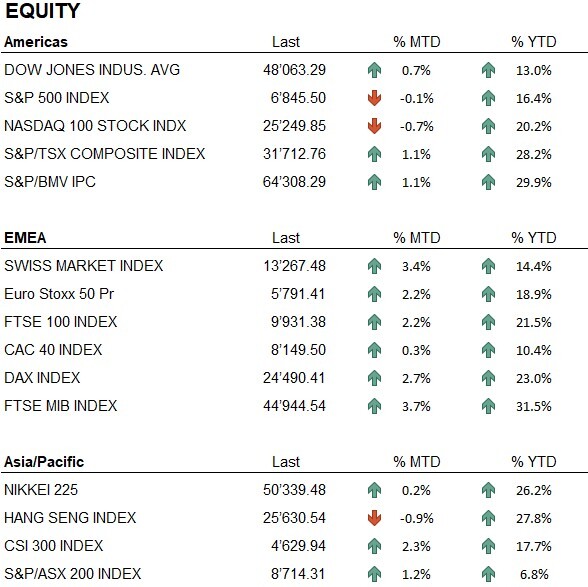
In the United States, the main stock indices posted solid double-digit performances. The S&P 500 closed the year up +16.4%, the Nasdaq 100 up +20.2%, and the Dow Jones up +13.0%. This result was supported by steady corporate earnings and expectations of a gradual easing of monetary policy by the Federal Reserve, which began cutting rates during the year after a prolonged restrictive cycle. In December, US markets experienced more moderate price movements than in previous months, reflecting a natural consolidation phase after the strong gains accumulated earlier in the year.
In Europe, 2025 was particularly positive. The Euro Stoxx 50 closed the year with growth of +18.9%, while some national markets posted even stronger results. The German DAX +23.0% and the Italian FTSE MIB +31.5% stood out for the strength of the cyclical and financial sectors, also benefiting from the European Central Bank’s gradual start to reducing interest rates. The Swiss market also ended the year on a positive note, with the SMI up +14.4%, supported by defensive and pharmaceutical sectors.
In the Asia-Pacific region, market performance was more mixed but overall constructive on a full-year basis. The Nikkei 225 rose +26.2%, supported by the weakness of the yen and the solid earnings of exporting companies. Chinese markets showed signs of recovery, with the CSI 300 up +17.7%, while the Hang Seng closed the year with a performance of +27.8%, although it remained more volatile than other regions.
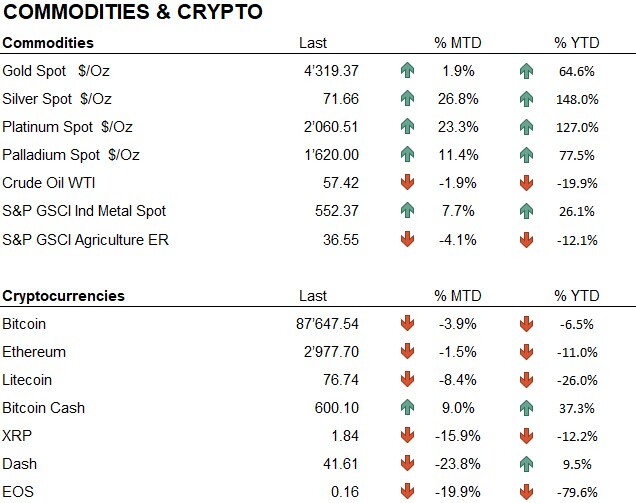
In the commodities sector, gold confirmed its role as a diversification tool, closing the year at $4,319 per ounce, up approximately +65%. Oil, on the other hand, ended 2025 down -20%, reflecting a more moderate global demand environment.
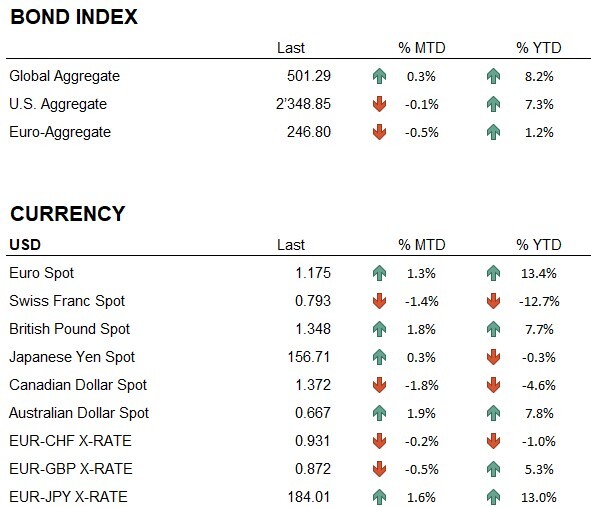
In the currency market, the strengthening of the euro against the US dollar helped to support the performance of European markets in local currency.
The cryptocurrency sector experienced a more complex year: Bitcoin closed 2025 in negative territory, despite the halving event, in line with consolidation phases that have historically followed such events.
Economy
In December, the macroeconomic picture continued to show signs of gradual normalization, with inflation slowing and economic activity remaining broadly resilient across major developed economies. In the United States, available data confirmed a gradual cooling of the economy, with no signs of a sharp deterioration.
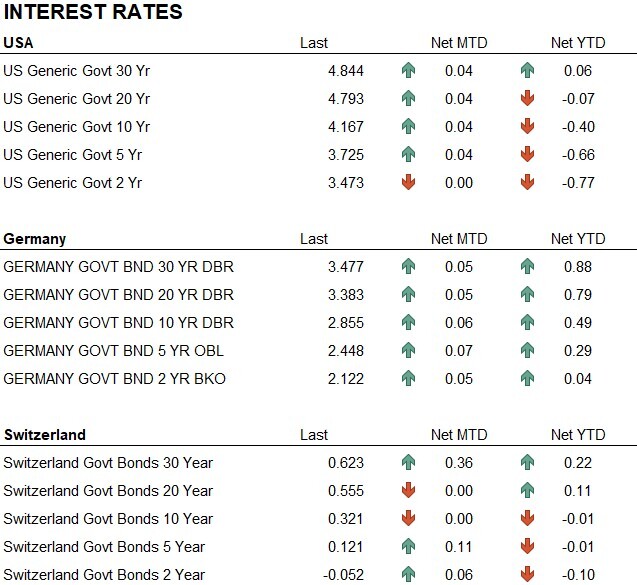
Monetary policy remained a central feature of the economic environment. During 2025, the Federal Reserve began a cycle of rate cuts, while the ECB and Swiss National Bank adopted a more accommodative stance; the Bank of Japan, on the other hand, bucked the trend, raising rates for the first time in decades. This divergence in monetary policies reflects differences in economic cycles and contributes to a more complex global backdrop.
Against this backdrop, financial conditions remained favorable overall, with credit spreads at historically low levels, supported by strong investor demand for most of the year. Market expectations gradually shifted toward a normalization path in 2026, while maintaining a high degree of attention to developments in inflation, growth, and financial stability.
.
Geopolitics
On the European front, the conflict in Ukraine continues without any concrete signs of de-escalation, remaining a factor of instability for regional security and energy dynamics. The lack of significant progress on the diplomatic front keeps the level of uncertainty high, contributing to geopolitical risk remaining a persistent element of the macroeconomic environment.
At the same time, early 2026 saw a significant escalation in Latin America, with a US military operation in Venezuela leading to the capture of President Nicolás Maduro. The episode generated strong international reactions, including criticism from Russia, China, and the United Nations, reigniting tensions between the major powers. Overall, these developments confirm that the geopolitical context remains complex and multilateral, continuing to influence the perception of global risk.
Conclusions
We are closing 2025 with an overweight equity component and a slightly overweight position in gold. On the bond front, we are maintaining a selective and cautious approach, consistent with a scenario of gradually normalizing interest rates that remains subject to uncertainty. Liquidity continues to be managed in order to preserve operational flexibility. Geographically, we maintain an overall neutral positioning across the different regions, in line with the signals from our model.
The month was characterized by frequent changes in direction and continued high volatility. Markets are monitored daily and the portfolio is adjusted regularly to maintain a positioning consistent with the evolving environment; the asset allocation reported represents a snapshot at the end of the month.
With 2026 shaping up to be a complex year from a political, monetary, and macroeconomic perspective, the management approach remains focused on flexibility and adaptation to changing conditions
Allocation
Liquidity

Bonds

Equity

Precious metals & Commodities

Geo-tactical allocation
Switzerland

Western Europe ex Switzerland
North America
Latin America
Asia Pacific
Top sectors
- Information Technology
- Health Care
- Consumer Discretionary
Market data (data as of 31.12.2025)
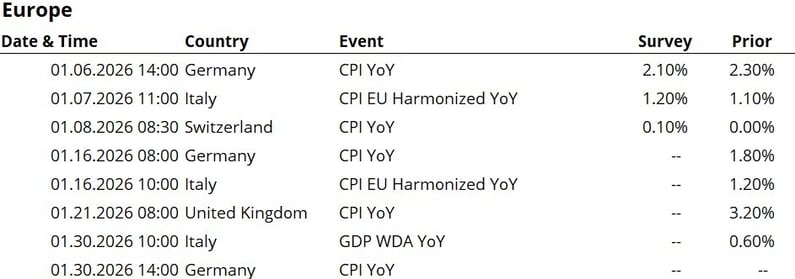
Event calendar

Legend
|
CPI: Consumer Price Index GDP: Gross Domestic Product FOMC: Federal Open Market Commitee BOJ: Bank of Japan |
FED: Federal Reserve System EIB: European Investment Bank BOE: Bank of England SNB: Swiss National Bank |
ZEW: Zentrum für Europeische Wirtschaftsforschung (Center for European Economic Research) YoY: Year on Year MoM: Month on Month |
Disclaimer: the content of this document is provided by i Partners SA (hereinafter iP) for information purposes only and is intended for internal use only. It does not in any way constitute an offer or recommendation to buy or sell a security or to carry out any type of transaction. Nor does it constitute any other type of advice, in particular to any recipient who is not a qualified, accredited, eligible and/or professional investor. It is to be used solely by its recipient and must not be forwarded, printed, uploaded, used or reproduced for any other reason. iP, cannot guarantee that the information contained herein is relevant, accurate or comprehensive. Accordingly, iP and its directors, officers, employees, agents and shareholders accept no responsibility for any loss or damage that may result from the use of the information contained herein. The content is intended solely for recipients who understand and bear all implicit and explicit risks involved. iP assumes no responsibility for the suitability or unsuitability of the information, opinions, securities or products mentioned herein. Past performance is no guarantee of future performance.