
Index
Markets
The summer months brought a stronger appetite for risk following the turbulence seen in the spring. Compared with the June update, the picture has changed significantly. The correction that had affected technology, cryptocurrencies and precious metals has largely been absorbed, while the dollar has lost some of the strength it had gained in June. After another uncertain month for the technology sector in July, August saw a clear return of buying interest in equities, gold and digital assets.
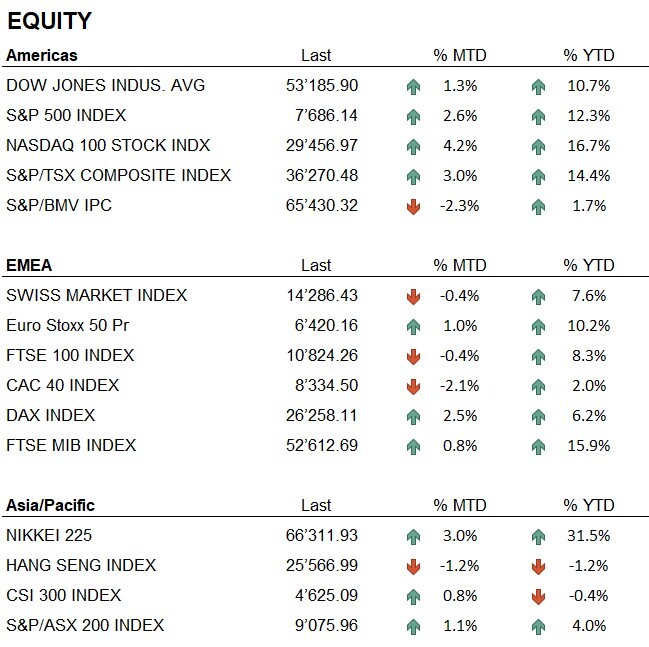
In the United States, technology led the recovery in August. The Nasdaq 100 gained 4.2%, the S&P 500 rose 2.6% and the Dow Jones added 1.3%, recovering from the weakness seen in the previous month.
In Europe, performance was more mixed. The DAX (+2.5%) and the Euro Stoxx 50 (+1.0%) ended the month in positive territory, while the CAC 40 (-2.1%), the SMI and the FTSE 100 (both -0.4%) lost ground. The FTSE MIB nevertheless remains the best-performing index in the region since the start of the year, with a gain of 15.9%.
In Asia, the Nikkei continued its rally and reached new all-time highs, gaining 3.0% during the month and 31.5% since the start of the year. Chinese markets were more mixed, with the Hang Seng down 1.2% and the CSI 300 up 0.8%.
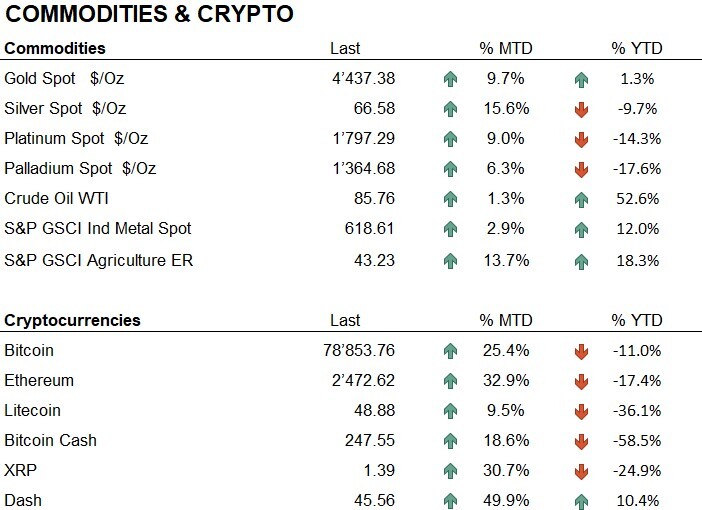
On the commodities side, the summer reversed the trends seen in June. Gold recovered strongly, gaining 9.7% in August and moving back into positive territory for the year (+1.3%). The rise also extended to other precious metals, with silver up 15.6%, platinum up 9.0% and palladium up 6.3%, although all three remain negative for the year. WTI crude oil consolidated around $86 (+1.3%) after its strong summer recovery.
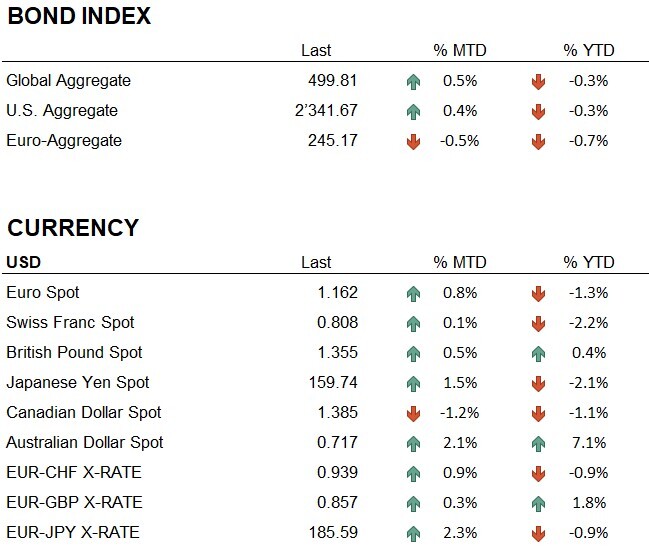
In the foreign exchange market, the dollar was weaker than in June. The euro rose 0.8% and sterling 0.5%. The yen remained the weakest among the major currencies (-1.5%), while the Swiss franc was almost unchanged. Cryptocurrencies also saw a strong recovery over the summer, with Bitcoin up 25.4% and Ethereum up 32.9%, although both remain negative since the start of the year.
Economy
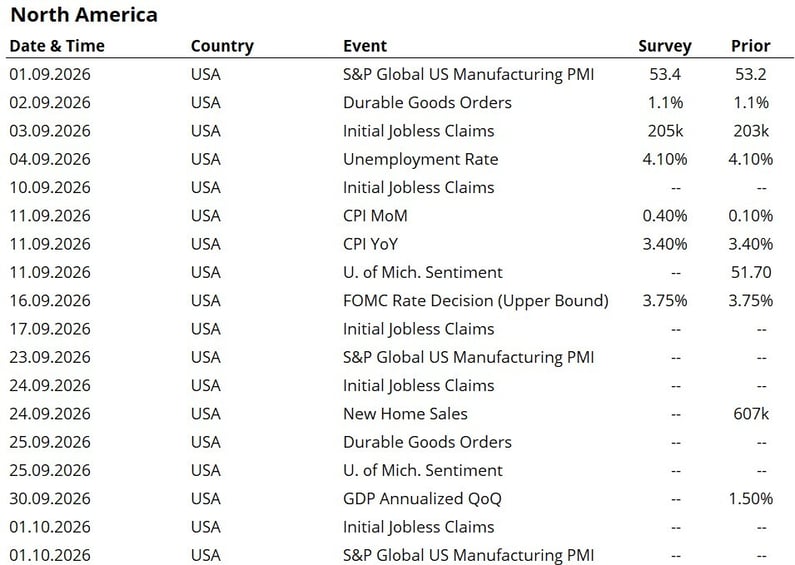
Over the summer, central banks confirmed the shift in tone that emerged in June, although no further moves on interest rates followed. On July 29, the Federal Reserve left rates unchanged in the 3.50%–3.75% range for the fifth consecutive meeting, with a 9–3 vote. Three regional presidents supported a 25-basis-point increase, as inflation remained above target. Warsh kept his communication brief and to the point, describing the decision not so much as a pause, but rather as a reassessment of the economic outlook.
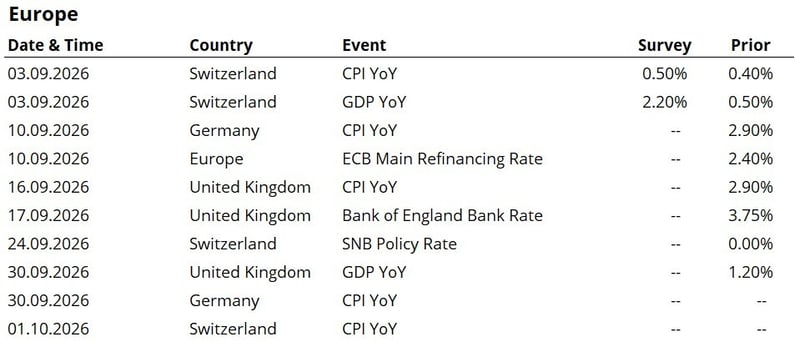
Meanwhile, U.S. inflation slowed for the second consecutive month, easing to 3.4% in July, with core inflation at 2.5%, further away from the 4.2% peak recorded in May. Signs of cooling also came from the labour market, with 23,000 jobs lost in July and the unemployment rate at 4.1%, although the decline was mainly due to lower labour force participation. Attention now turns to the FOMC meeting on September 15–16, when the new economic projections will also be released.
In Europe, following the surprise rate hike in June, the first since 2023, the ECB left its deposit rate unchanged at 2.25% at its July 23 meeting. The ECB nevertheless made clear that the pause does not necessarily mark the end of the tightening cycle. It remains the only major central bank still leaning towards further rate increases, with markets still seeing a possible move to 2.50% in September.
Eurozone inflation also picked up again over the summer, rising from 2.8% in June to 3.3% in the August flash estimate, mainly due to the energy component.
Geopolitics
The memorandum of understanding signed on June 18 between the United States and Iran was short-lived. By early July, the truce had already broken down. Washington declared that the ceasefire was no longer in effect and imposed new sanctions, while Tehran accused the United States of violating the agreements on the nuclear issue. On July 12, the Revolutionary Guards announced a new closure of the Strait of Hormuz. The United States responded by resuming airstrikes and reinstating the naval blockade.
In the following weeks, mediation increasingly shifted towards Iran and Oman, with Qatar becoming involved again at the end of August. A broad agreement was reached on the management of routes through the Strait, but Tehran continues to link its reopening to U.S. concessions, including an easing of sanctions and war reparations. Washington has so far rejected these conditions.
The impact on markets remains significant. Around one-fifth of the world’s crude oil passes through the Strait of Hormuz, and traffic remains sharply reduced, keeping a risk premium on oil prices. After falling below $80 in early August on expectations of a possible agreement, Brent has moved back to around $84, roughly 16% above pre-conflict levels.
A return to normal conditions therefore appears to be taking longer than was anticipated in June.
Conclusions
We end the summer with our positioning broadly in line with June, following a period of higher volatility over the summer.
The recovery in equities, gold and digital assets in August confirmed our overweight stance on equities. We have now added a slight overweight in gold, supported by the improvement in relative momentum. We remain neutral on bonds and slightly underweight cash. At the sector level, we continue to favour Financials, Information Technology and Industrials.
The summer once again showed how quickly the market environment can change. The memorandum between the United States and Iran broke down within a matter of weeks, bringing back a risk premium on oil. At the same time, after a difficult July for technology, August saw a strong recovery in equities, gold and cryptocurrencies. Meanwhile, the Fed and the ECB chose to wait for further data before taking any additional action.
Allocation
Liquidity

Bonds

Equity

Precious metals & Commodities

Geo-tactical allocation
Switzerland
Western Europe ex Switzerland
North America
Latin America
Asia Pacific
Top sectors
- Financials
- Information technology
- Industrials
Market data (data as of 31.08.2026)
Event calendar
Legend
|
CPI: Consumer Price Index GDP: Gross Domestic Product FOMC: Federal Open Market Committee BOJ: Bank of Japan |
FED: Federal Reserve System EIB: European Investment Bank BOE: Bank of England SNB: Swiss National Bank |
ZEW: Zentrum für Europeische Wirtschaftsforschung (Center for European Economic Research) YoY: Year on Year MoM: Month on Month |
Disclaimer: the content of this document is provided by i Partners SA (hereinafter iP) for information purposes only and is intended for internal use only. It does not in any way constitute an offer or recommendation to buy or sell a security or to carry out any type of transaction. Nor does it constitute any other type of advice, in particular to any recipient who is not a qualified, accredited, eligible and/or professional investor. It is to be used solely by its recipient and must not be forwarded, printed, uploaded, used or reproduced for any other reason. iP, cannot guarantee that the information contained herein is relevant, accurate or comprehensive. Accordingly, iP and its directors, officers, employees, agents and shareholders accept no responsibility for any loss or damage that may result from the use of the information contained herein. The content is intended solely for recipients who understand and bear all implicit and explicit risks involved. iP assumes no responsibility for the suitability or unsuitability of the information, opinions, securities or products mentioned herein. Past performance is no guarantee of future performance.