
Index
Markets
June 2026 marked a shift in the market landscape compared to May’s trends, with inflation and interest rate expectations once again taking center stage for investors. The month began with better-than-expected U.S. employment data, which reduced the likelihood of a rate cut by the Fed in the near term. Midway through the month, the agreement between the United States and Iran to reopen the Strait of Hormuz led to a sharp drop in oil prices after months of gains, while in the final week, a global sell-off in tech stocks brought volatility back to the equity markets, triggered by rumors of a possible delay in OpenAI’s IPO.
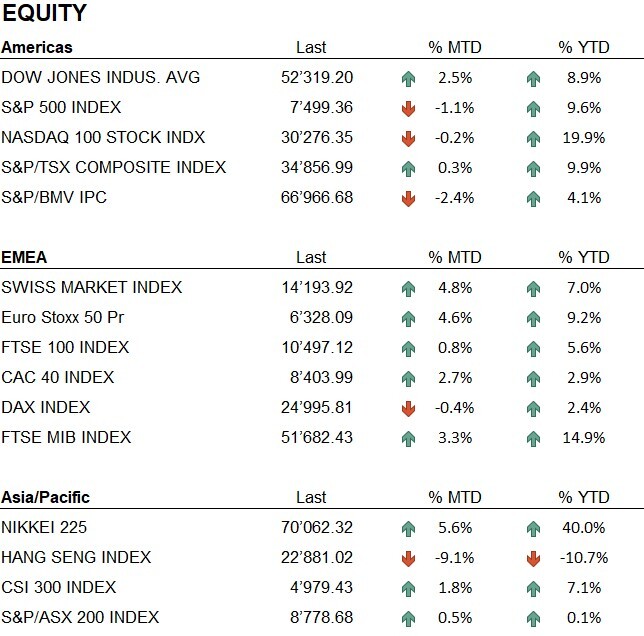
In the United States, performance was mixed: the Dow Jones gained 2.5%, while the S&P 500 and the Nasdaq 100 closed slightly lower (-1.1% and -0.2%), weighed down by a correction in the semiconductor sector. Year-to-date gains remain solid, with the Nasdaq 100 up 19.9%. In Europe, the rise was more pronounced: SMI +4.8%, Euro Stoxx 50 +4.6%, FTSE MIB +3.3%, CAC 40 +2.7%, FTSE 100 +0.8%, DAX -0.4%. In Asia, the Nikkei hit new all-time highs above 72,000 on June 22, closing up 5.6%; the Hang Seng fell 9.1%, posting its weakest monthly performance of the year, weighed down by the correction in Chinese tech stocks, while the CSI 300 held up better (+1.8%).
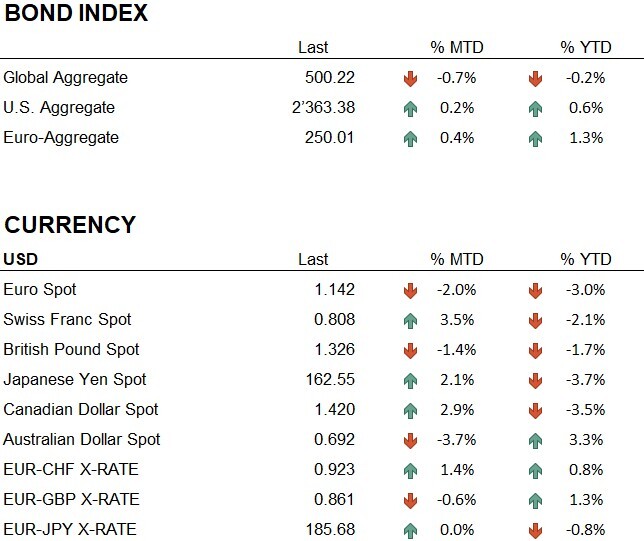
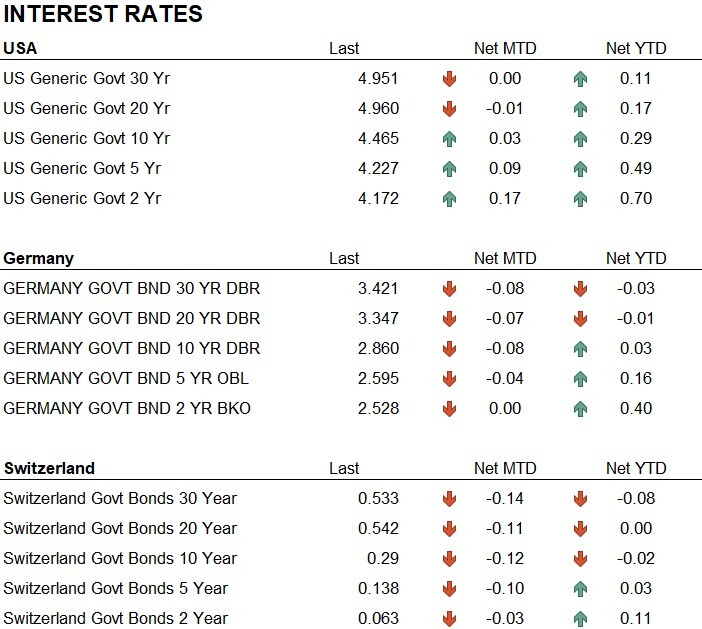
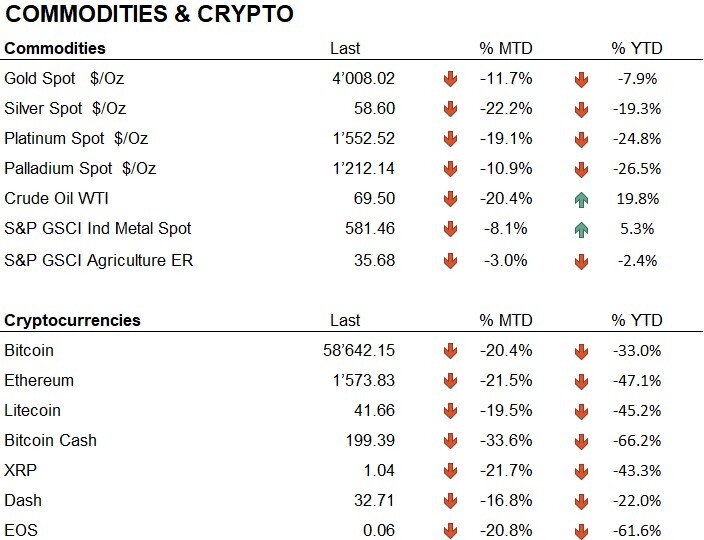
WTI crude oil experienced a month mirroring May’s performance, falling 20.4% and returning to the $69-per-barrel range—its lowest level since the start of the conflict. Gold, on the other hand, posted a significant decline (-11.7% for the month, -7.9% year-to-date), dragging down the entire precious metals sector, with silver down 22.2%, platinum down 19.1%, and palladium down 10.9%. The dollar strengthened, with the euro losing 2.0% and the pound losing 1.4%. Bitcoin lost 20.4% for the month (-33.0% year-to-date) and Ethereum lost 21.5% (-47.1% year-to-date). The bond market also saw a marked divergence, with U.S. yields rising across the curve—particularly at short maturities—while German and Swiss yields fell.
Economy
On the central bank front, June marked the first real test for Kevin Warsh. On June 17, the Federal Reserve left rates unchanged in the 3.50%–3.75% range but removed language from its statement that had hinted at possible cuts. The new dot plot shows nine out of eighteen members in favor of at least one rate hike by year-end—a shift from March, when the committee was still anticipating a cut in 2026. Inflation in the United States rose to 4.2% in May—the highest level in the past three years—driven by rising energy prices linked to the conflict in the Middle East, while the labor market remains surprisingly resilient, with unemployment holding steady at 4.3%.
In Europe, by contrast, the ECB raised rates by 25 basis points on June 11—its first hike since 2023—bringing the deposit rate to 2.25%. The decision comes after inflation in the Eurozone rose to 3.2% in May (core inflation at 2.5%), with the ECB’s new projections forecasting average inflation of 3.0% in 2026 and growth revised slightly downward to 0.8%. Lagarde described the decision as sound across all scenarios, emphasizing that the duration of the conflict in the Middle East remains the key variable for upcoming meetings. The SNB, for its part, remains committed to an accommodative stance, with Swiss yields at historic lows and no signs of a rise on the horizon.
Geopolitics
On June 18, the United States and Iran signed a memorandum of understanding to end hostilities, with Tehran committing to reopen the Strait of Hormuz and Washington agreeing to lift the naval blockade of Iranian ports. The agreement, brokered by Pakistan, calls for a ceasefire of at least 60 days, extended to the Lebanese front as well. In the weeks that followed, the path proved less straightforward than expected, with mutual accusations of ceasefire violations, Iranian missiles fired toward Kuwait, and Israeli airstrikes continuing in southern Lebanon. The issue of Iran’s nuclear program remains the main obstacle to a final agreement, with Tehran making access for IAEA inspectors contingent on the signing of a broader agreement. At the end of the month, maritime traffic in the Strait remained well below pre-war levels, and Goldman Sachs forecasts a normalization of Gulf exports by the end of July, with regional production expected to return to pre-conflict levels only in October.
Conclusions
We close out June 2026 with a position that has returned to a constructive stance, following a period of greater caution during the month. The signals we received in June had led us to increase liquidity, in a context dominated by the Fed's hawkish repricing and the collapse of gold and cryptocurrencies. Toward the end of the month, as equity markets rebounded, the signals once again pointed toward an overweight equity position, which is how we ended the month. We remain neutral on gold and bonds, while liquidity remains slightly underweight. At the sector level, we now favor Information Technology, Financials, and Communication Services.
The month confirmed how quickly the landscape can shift within a few weeks: on one hand, the U.S.-Iran agreement sent oil prices plummeting; on the other, the return of inflation and Warsh's shift toward a restrictive stance wiped out gains in gold, cryptocurrencies, and part of the tech rally. In such volatile environments, tactical management remains crucial, and the ability to adjust allocation based on daily signals proved useful during the shift from liquidity to an overweight equity position in the final days of the month.
July begins with a packed agenda: the stability of the U.S.-Iran truce remains the top item to monitor, with new tensions already reported in late June. On the monetary front, attention shifts to upcoming U.S. inflation and employment data ahead of the late-July FOMC meeting, while we'll continue monitoring OpenAI's IPO, now a barometer for AI valuation sustainability. In an environment where oil, rates, and AI can shift direction within weeks, we continue to favor flexible allocation over static positioning.
Allocation
Liquidity

Bonds

Equity

Precious metals & Commodities
Geo-tactical allocation
Switzerland
Western Europe ex Switzerland
North America
Latin America
Asia Pacific
Top sectors
- Information Technology
- Financials
- Communication Services
Market data (data as of 30.06.2026)
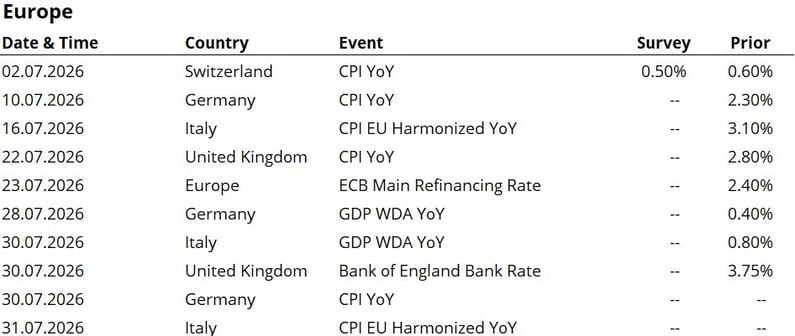
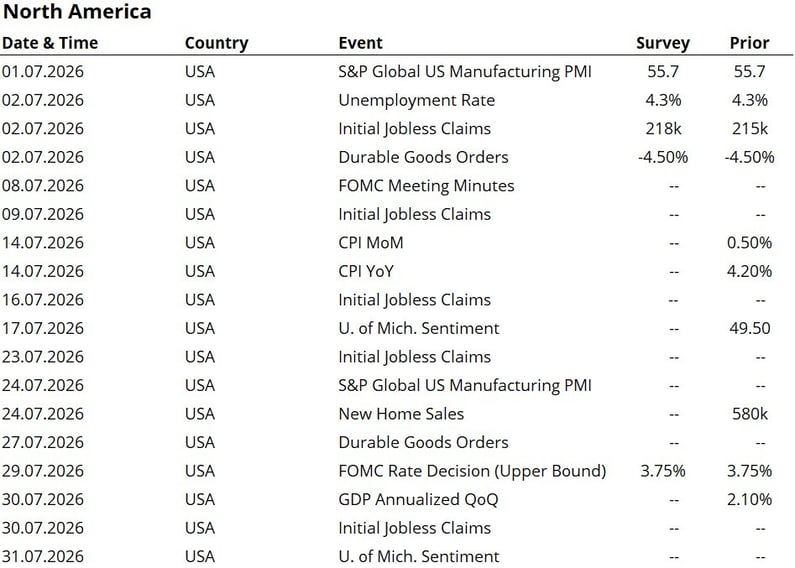
Event calendar
Legend
|
CPI: Consumer Price Index GDP: Gross Domestic Product FOMC: Federal Open Market Commitee BOJ: Bank of Japan |
FED: Federal Reserve System EIB: European Investment Bank BOE: Bank of England SNB: Swiss National Bank |
ZEW: Zentrum für Europeische Wirtschaftsforschung (Center for European Economic Research) YoY: Year on Year MoM: Month on Month |
Disclaimer: the content of this document is provided by i Partners SA (hereinafter iP) for information purposes only and is intended for internal use only. It does not in any way constitute an offer or recommendation to buy or sell a security or to carry out any type of transaction. Nor does it constitute any other type of advice, in particular to any recipient who is not a qualified, accredited, eligible and/or professional investor. It is to be used solely by its recipient and must not be forwarded, printed, uploaded, used or reproduced for any other reason. iP, cannot guarantee that the information contained herein is relevant, accurate or comprehensive. Accordingly, iP and its directors, officers, employees, agents and shareholders accept no responsibility for any loss or damage that may result from the use of the information contained herein. The content is intended solely for recipients who understand and bear all implicit and explicit risks involved. iP assumes no responsibility for the suitability or unsuitability of the information, opinions, securities or products mentioned herein. Past performance is no guarantee of future performance.