
Index
Markets
April 2026 ended with broad gains across major global stock markets, reversing the trend from the previous month. The truce reached between the United States and Iran eased geopolitical tensions and restored market confidence, supported by a broadly positive earnings season. Investor focus gradually shifted from geopolitical risks to economic fundamentals, with the technology sector leading the recovery.
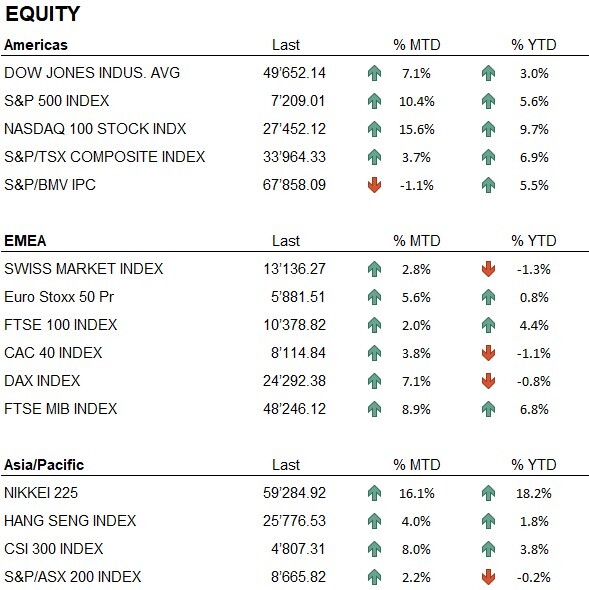
In the United States, the Nasdaq 100 gained 15.6%, the S&P 500 10.4%, and the Dow Jones 7.1%, bringing all three indices into positive territory year-to-date. In Europe, the recovery was more modest: FTSE MIB +8.9%, DAX +7.1%, Euro Stoxx 50 +5.6%, CAC 40 +3.8%, SMI +2.8%, and FTSE 100 +2.0%. In Asia, the Nikkei led the rebound with a gain of 16.1%, followed by the Hang Seng at 4.0% and the CSI 300 at 8.0%.
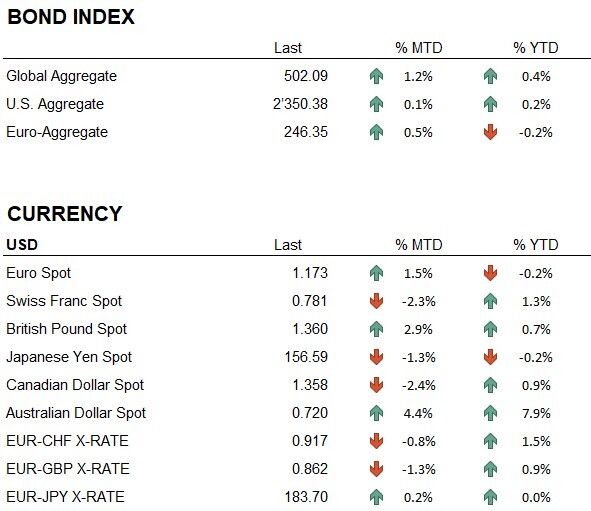
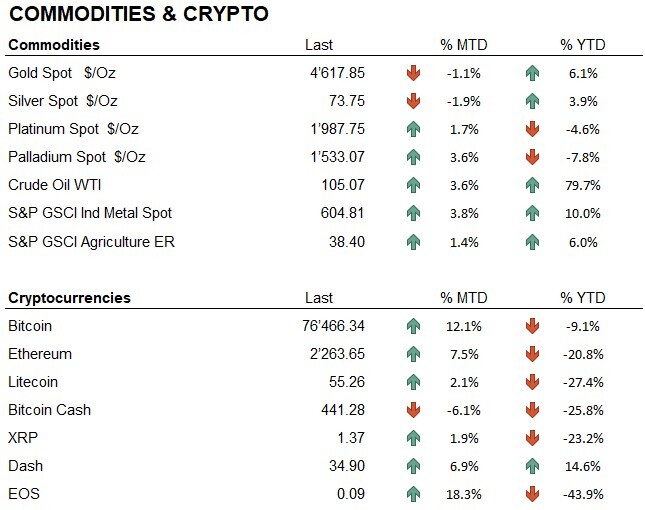
WTI crude oil closed at $105 per barrel, up 3.6% for the month. News of the ceasefire had initially sent prices lower, but doubts about its durability quickly erased those losses. Gold posted a slight decline of 1.1%. On the currency front, the dollar weakened over the month: the Swiss franc appreciated by 2.3% against the dollar and the euro by 1.5%. Bitcoin gained 12.1% and Ethereum 7.5%.
Economy
On the central bank front, April confirmed the wait-and-see stance that had already emerged in March, with major monetary authorities keeping rates unchanged but with increasingly divided internal views. At its April 29 meeting, the Fed kept rates unchanged in the 3.50%-3.75% range, but with an unusual internal split: one member voted for an immediate cut, while three called for a less accommodative tone in the statement. The 8-4 vote marks the most divided FOMC since October 1992. March’s PCE data pushed the Fed’s preferred inflation measure to 3.5% annually, confirming how the energy shock is feeding through to prices. Powell, at his final press conference as chair, confirmed he will remain on the committee as a governor. Kevin Warsh is expected to take over as chair on May 15, with the first meeting under his leadership scheduled for June. Markets are not pricing in any rate changes for the remainder of 2026 and do not anticipate cuts even in the first half of 2027.
In Europe, the picture is different. The ECB left rates unchanged at 2.00% at its April 30 meeting, in a unanimous decision. Lagarde noted, however, that the meeting included a lengthy discussion of various options, including a rate hike, signaling a more heated internal debate than in recent months. The macroeconomic outlook remains challenging: inflation in the Eurozone reached 3% in April, a two-and-a-half-year high, while first-quarter GDP fell short of expectations. Markets expect a series of rate hikes in the second half of 2026, with the first move anticipated as early as June. Frankfurt has deferred any more concrete guidance to the new projections in June. The Bank of England also kept rates at 3.75%, in line with expectations.
Geopolitics
April 2026 marked the transition from open conflict to a phase of fragile truce, with no definitive solution yet in sight. President Trump announced the acceptance of a two-week ceasefire, contingent upon the reopening of the Strait of Hormuz, with the stated aim of creating an opportunity for a broader agreement. The ceasefire went into effect on April 7, after nearly forty days of Israeli-U.S. attacks against Iran and retaliatory strikes by Tehran.
On the diplomatic front, Pakistan assumed the role of chief mediator, hosting negotiations between the parties. Iran presented a two-phase proposal: immediate reopening of the Strait followed by the launch of nuclear talks, a proposal that Trump, however, deemed unsatisfactory. Washington insisted on conditions deemed non-negotiable, including the transfer of all enriched uranium stocks out of Iran, while Tehran made any progress contingent on the immediate lifting of the naval blockade and sanctions. Trump extended the truce to allow for further room for negotiation, but the positions of the two sides remain far apart.
The Strait of Hormuz remains the central issue: its reopening is both a condition and an objective of the negotiations, with direct effects on global energy markets. The nuclear dossier, postponed to a second phase of the talks, continues to represent the most complex issue to resolve.
Conclusions
We end April 2026 with a constructive positioning. We are overweight in equities, slightly overweight in gold, while bonds remain neutral and cash is slightly underweight. At the sector level, we favor Energy, Information Technology, and Materials—sectors that have benefited to varying degrees from the current environment, marked by persistently high energy prices and investors’ return to structural growth themes.
The month confirmed just how quickly the market can change, as demonstrated by oil price movements, which fell sharply on news of the ceasefire and recovered almost entirely within a few days. In such a context, tactical management makes all the difference. Our asset allocation product operates using daily signals that allow us to quickly increase or reduce equity exposure, adapting our positioning to market developments.
The start of May is still unfolding against a backdrop of uncertainty. The ceasefire holds, but negotiations between Washington and Tehran remain complex, with positions still far apart on the nuclear issue and the Strait of Hormuz. Active management remains the most appropriate approach for navigating a phase in which a single diplomatic development can rapidly alter the landscape.
Allocation
Liquidity

Bonds

Equity

Precious metals & Commodities

Geo-tactical allocation
Switzerland
Western Europe ex Switzerland
North America
Latin America
Asia Pacific
Top sectors
- Energy
- Information Technology
- Materials
Market data (data as of 30.04.2026)
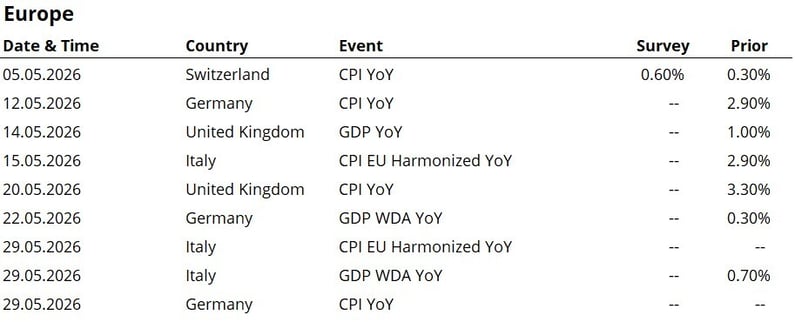
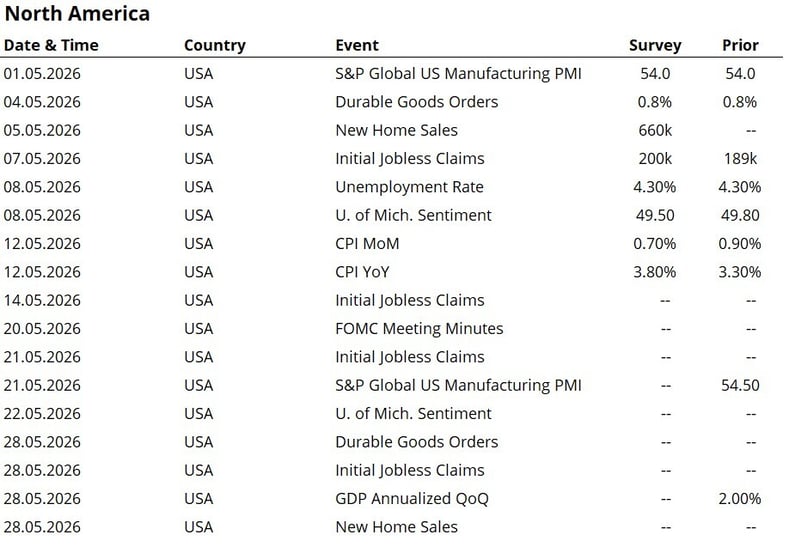
Event calendar
Legend
|
CPI: Consumer Price Index GDP: Gross Domestic Product FOMC: Federal Open Market Commitee BOJ: Bank of Japan |
FED: Federal Reserve System EIB: European Investment Bank BOE: Bank of England SNB: Swiss National Bank |
ZEW: Zentrum für Europeische Wirtschaftsforschung (Center for European Economic Research) YoY: Year on Year MoM: Month on Month |
Disclaimer: the content of this document is provided by i Partners SA (hereinafter iP) for information purposes only and is intended for internal use only. It does not in any way constitute an offer or recommendation to buy or sell a security or to carry out any type of transaction. Nor does it constitute any other type of advice, in particular to any recipient who is not a qualified, accredited, eligible and/or professional investor. It is to be used solely by its recipient and must not be forwarded, printed, uploaded, used or reproduced for any other reason. iP, cannot guarantee that the information contained herein is relevant, accurate or comprehensive. Accordingly, iP and its directors, officers, employees, agents and shareholders accept no responsibility for any loss or damage that may result from the use of the information contained herein. The content is intended solely for recipients who understand and bear all implicit and explicit risks involved. iP assumes no responsibility for the suitability or unsuitability of the information, opinions, securities or products mentioned herein. Past performance is no guarantee of future performance.